And a new look!
I’ve moved…I’m still Real Delia , but I have a whole new look and feel.
Please come over and join the party at realdelia.com.
And a new look!
I’ve moved…I’m still Real Delia , but I have a whole new look and feel.
Please come over and join the party at realdelia.com.
 Leave a Comment » |
  Blogging |
  Permalink
 Posted by delialloyd
Apologies if you’ve been trying to access the blog and had trouble. The blog is shortly to undergo a re-design and we have hit a few speed bumps along the way. Thanks for your patience. Stay tuned for RealDelia 2.0, coming soon to a theatre near you!
Every Friday I point you towards some recommended reading around the blogosphere:
1. Here’s a four year-old named Nina explaining the situation in Egypt.
2. Further to the ongoing discussion here and elsewhere about the future of journalism, here’s what The New York Times would look like if it became a content mill at search engine land.
3. While we’re at it, here’s Politico’s prize-winning comic Matt Wuerker’s take on the AOL-Huffpo merger at Fish Bowl DC.
4. Because you just might need it one day, have a look at this list of commonly used words and expressions in Yiddish. (I’ve always wondered how you spell “broche…”)
5. Finally, I really liked this thoughtful post by Nichole Bernier at Beyond The Margins about the effect of technology on fiction writers’ plot devices.
Have a great weekend!
Leave a Comment » | Recommended Reading | Tagged: AOL-Huffpo merger, common expressions in Yiddish, future of journalism, Matt Wuerker, New York Times as content mill, nichole bernier, Nina explains Egypt, technology and plot devices | Permalink
Posted by delialloyd
 Apologies if you’ve been trying to access the blog and had trouble. The blog is shortly to undergo a re-design and we have hit a few speed bumps along the way. Thanks for your patience. Stay tuned for RealDelia 2.0, coming soon to a theatre near you!
Yesterday I posted on the changes afoot over at Politics Daily and their practical implications for freelance writers like myself in forcing us to be more enterprising.
Today I wanted to address the emotional side of that equation.
As I think I’ve mentioned at several points over the past couple of years, I’ve had an absolute blast working at Politics Daily. When I started there, I’d taken a few years off from journalism to write a novel and launch this blog. So it felt great to roll up my sleeves and dive back into the brainstorming, research and reporting that goes into being a journalist. It was also a lot of fun to return to the sorts of international topics that I once taught and wrote about as a scholar.
And because the website was starting from scratch as a player in Online political journalism, I got to learn by doing about this thing we call ” new journalism” and all of the social media tools and 24/7 news frenzy that goes with it.
In short, it has been – and continues to be – a great learning and growth experience for me professionally.
Above all, however, the main reason that I have loved working at Politics Daily has been the community that grew up around it. It’s true of the publication as a whole and its top-notch columnists and editors. What a super crew. And it’s especially true of my little corner of the world there: Woman Up.
You’ve seen a lot of the work I’ve done for them over the past two years on this very page: stories about the economics of abortion and the reality of socialized medicine as well as why I think it’s time to life the Cuba embargo and the connection between universities and terrorism.
But what you don’t see is the lovely and supportive community of women that’s grown up behind that space along the way. Most of us didn’t know each other before Woman Up began. Now we chat constantly with each other On line. We share story ideas. We laugh. We argue. We write.
I wrote a post a few weeks back on this blog about the importance of making real-life friends. Woman Up has by in large been a virtual community of friends for me (although I did have the enormous pleasure of meeting many of the ladies in person at a cocktail party in Washington, D.C. over the holidays.) But even as a virtual coffee clutch, it’s been a vital part of my social and intellectual life for the past few years.
This virtual cocktail party (did you notice how I just seamlessly escalated us from coffee to vodka?) may now come to an end, at least in its present incarnation. We’ll know for sure soon. But even if it carries on under a different banner, it will likely be different.
That’s not necessarily a bad thing. I like change, after all. And the only thing that’s constant in life is change, so they say. But regardless of how things shape up in the future, I’m incredibly grateful to have been a part of this fine group of female journalists.
As I live in London, we normally “raise a glass” on occasions like this and say “Cheers.”
But my Irish grandmother always said it in Gaelic: “Slainte.”
So Slainte, ladies. It’s been a great ride.
May it continue.
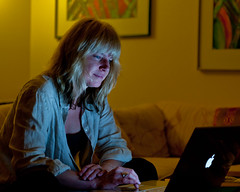
Image: Laura at Computer by panguy100 via Flickr under a Creative Commons license.


3 Comments | Relationships, Work, Writing | Tagged: community for writers, Online friends, the importance of female friends, Woman Up Politics Daily | Permalink
Posted by delialloyd
Apologies if you’ve been trying to access the blog and had trouble. The blog is shortly to undergo a re-design and we have hit a few speed bumps along the way. Thanks for your patience. Stay tuned for RealDelia 2.0, coming soon to a theatre near you!
 Every Wednesday I offer tips for adulthood.
On her inspiring e-zine, The Prosperous Writer, Christina Katz has a great post this week about the need for writers to be enterprising. Christina defines enterprising as “ready to undertake projects of importance or difficulty or characterized by great imagination or initiative.”
For her, it’s about undertaking projects that will change you and cause you to grow. It’s about getting inspired. And it’s definitely not about being passive, timid or cautious.
Christina’s exhortation is well-timed. If you’ve been following the news this week, you probably know that shortly after midnight on February 7th, AOL announced that it had purchased The Huffington Post and the two companies will now merge into one media behemoth.
AOL is the parent company of Politics Daily, where I’ve been freelancing for the past two years along with a slew of other journalists. At the moment, the future of our publication is somewhat uncertain.
As that process sorts itself out, both practical and emotional factors come into play. I’ll have more to say about the emotional side of things some other time. On the practical end, however, the sudden, overnight upheaval at Politics Daily is a fresh reminder that freelancing is an inherently unstable endeavor, especially in the current economy.
Which means that in order to survive, you really need to be…well, enterprising. Here are five ways freelancers can be enterprising in their careers:
1. Diversify Your Projects. There are lots of reasons to take on different kinds of projects as a freelancer. It keeps you fresh. You learn new skills. You increase your chances of getting more work. But in today’s economy, it’s also a necessity. Relying on a steady gig is great…until it’s no longer there. So by all means get out there and expand your portfolio. It hedges against risk…and you might just discover something new that you love.
2. Exploit Your Network. One way to diversify your skill set is to draw on contacts you have in other parts of your life to drum up new business ideas. Through a casual acquaintance at my daughter’s school, I landed a gig last week writing about home improvement for a magazine targeted at retired people. What did I know about the Small Office Home Office (that’s SOHO to me and you) before I started? Zip. But I learned. And now they’ll likely ask me to do more. In a similar vein, the other day I was working in the cafe attached to my yoga studio when I struck up a conversation with the owner. Afterwards, it occurred to me that he might be interested in advertising on my new blog once it’s up and running. And so on…
3. Experiment. And while you’re at it, try something completely new. Career guru Marci Alboher recommends taking an inventory of your skills and talents to devise a list of potential paths you might pursue. If you teach, write or consult. If you write, teach. Etc., etc. I’ve recently signed on to teach a series of journalism workshops to secondary school (high school) students around London. That in turn led to an offer to teach adults in a continuing education program. A freelance consultant friend of mine who normally analyzes political risk for a living is working with a programmer to launch a new company. Experimentation is crucial to growth. And it will also sharpen your core skills.
4. Protect Your Assets. In what would now appear to be a particularly prescient post I wrote a few weeks back, I talked about the importance of backing up your files, especially if most of your work is Online. And that’s because while it’s generally true that things live forever on the internet, plenty of publications will – without warning – decide to yank your URLs and not link to them anymore. So yesterday – while monitoring the fate of Julian Assange – I went back and made PDFs of all of my Politics Daily articles…just in case.
5. Carry on. Change is distracting…and can be debilitating. So unless and until you know what’s coming next, the best thing you can do is to carry on with your work. In my case that means that all week long, I’ve kept pitching and I’ve kept writing. Because, to paraphrase a colleague, “We ain’t dead yet.” To wit?
Here’s my latest on the Berlusconi sex scandal.
Enjoy.
Image: My Online Business Card by Michael Kwan via Flickr under a Creative Commons license.


2 Comments | Current Events, Work, Writing | Tagged: AOL-Huffpo merger, berlusconi sex scandal, diversifying your portfolio as a writer, experimentation and growth, freelancing entrepreneurs, freelancing networking, freelancing recession, freelancing uncertainty | Permalink
Posted by delialloyd
Every Friday I point you towards some recommended reading around the blogosphere:
1. As we look ahead to what’s next for Egypt, I really liked this slideshow at Salon featuring different protesters in Cairo telling us why they are there.
2. Here’s a superb analysis by Paul Carr at TechCrunch of the difference between old and new journalism.
3. And speaking of journalism, here’s my latest at Politics Daily on Wikileaks and the future of journalism.
4. This fascinating (and funny!) video at the Brainiac blog on Boston.com explains the difference between the United Kingdom, Great Britain and the Commonwealth. It should be required reading for anyone – including yours truly – who thinks they get this, but actually don’t.
5. Equally compelling is the BBC’s new project – Dimensions – which shows you the human scale of events and places in history by mapping them onto your home address. (Hat tip: Very Short List)
6. I loved this piece by my colleague Carla Baranaukas over at Politics Daily on hiring a personal assistant.
7. Finally, I’m not sure what it says about me that I really wish someone would give me these as a Christmas present next year…


1 Comment | Recommended Reading | Tagged: BBC Dimensions, brainiac blog, Carla Baranaukas, egyptian protests slideshow, hiring a personal assistant, old vs. new journalism, paul carr, what is the united kingdom?, wikileaks and future of journalism | Permalink
Posted by delialloyd
Every Wednesday I offer tips for adulthood.
 When I was back in the States over the holidays, I had an interesting dinner conversation with a friend of a friend. I can’t remember how it got started, but suddenly there I was, listing my favorite all-time movies.
And in constructing my list out loud, I realized how many of my favorite films have to do with politics in some way, shape or form.
So since it’s Oscar season — and that always gets me thinking about the kinds of movies I like and why — I thought I’d share with you five political movies worth seeing:
1. Reds. This may be my all-time favorite movie, period. It’s about a radical American journalist – Jack Reed – who becomes involved with the Communist revolution in Russia and tries to bring its ideals to the United States. (He’s also the author of Ten Days That Shook The World, if that rings a bell.) Why do I like this movie so much? I find the history of communism – especially in the United States – to be pretty interesting stuff. But this is also an epic film, told over generations, which intersperses a story of global political change with Reed’s rocky but ultimately, loving relationship with his wife, Louise Bryant. Oh and the cast? Warren Beatty, Diane Keaton and a surprisingly toned-down and moving Jack Nicholson.
2. Julia. Another film about war, this time World War Two. This play centers on a friendship between two women – American playwright Lillian Hellman and her lifelong friend, Julia. When Julia joins the anti-Facist resistance movement in Vienna, she asks her old friend Lillian to smuggle some money to the cause while travelling through Europe. This is fundamentally a movie about the love between two friends (set against a broader backdrop of Nazi Germany, anti-Semitism and Hellman’s on-again, off-again relationship with Dashiel Hammett.) Jane Fonda and Vanessa Redgrave star, but don’t miss the five-minute scene with Maximilian Schell. Priceless.
3. All The President’s Men. Yeah, I know. Like Godfather II (which I also love), they re-broadcast this baby far too often on TV. But what a great movie. It’s goes right to the nexus of corruption, money and power in Washington. Best of all, the whole thing has a thriller-like feel. Personally? My favorite scene is the one where the Dustin Hoffman character stays up all night drinking coffee and pumping some lady for information. Makes one proud to be a journalist.
4. Nothing Personal. If, like me, you have a quiet obsession with The Troubles in Northern Ireland, I’d highly recommend a small but powerful film that flew a bit under the radar screen called Nothing Personal. It’s a very intimate portrait of a handful of people on both sides of this conflict and how their lives – political and personal – intersect in complicated and dangerous ways. Warning: the ending will kill you.
5. 4 Months, 3 Weeks and 2 Days. So this is a pretty harrowing film all around. It’s about illegal abortion under authoritarian rule in Romania. Not everyone’s cup of tea, I realize; definitely mine. But the reason I list it here under political films is that despite the grisly subject matter, the film is a statement – and a re-enactment, of sorts – of what it’s like to live under authoritarian rule. At a political moment when we’re all trying to figure out what’s going on in Egypt, this one is worth a watch. But be sure to fasten your seatbelt first.
What am I missing? Do weigh in in the comments section with your own favorite political films…
Image: Movie Theater by jimdeane via Flickr under a Creative Commons license.


4 Comments | Movies, Tips List | Tagged: 2 Days, 3 Weeks, 4 Months, All The Presidents Men, Films about politics, Julia, Nothing Personal, political films, Reds | Permalink
Posted by delialloyd
 As the abortion wars heat up once again, there’s a new study out that’s sure to add fuel to the fire. A leading medical journal reports that having an abortion may be less damaging to a woman’s mental health than having a baby.
The study — which was published in the New England Journal of Medicine last week — tracked 365,550 girls and women in Denmark who had a first-trimester abortion or first-time delivery between 1995 and 2007. Researchers selected females with no history of mental health problems prior to getting pregnant. They then compared the rate of mental health treatment (as measured by an inpatient admission or outpatient visit) within the 12 months after the abortion or childbirth as compared with the 9-month period preceding it.
The study found that women who had an abortion sought psychiatric treatment at roughly the same rate before and after that event, while the incidence with which women who gave birth sought counseling increased dramatically after having a baby.
Specifically, one percent of women sought help for possible mental disorders in the nine months before the abortion, while 1.5 percent did so in the 12 months that followed. On the other hand, 0.3 percent of women who gave live birth visited a psychiatrist for the first time in the nine months before birth compared to an average of 0.7 percent in the year that followed. So even though women seeking abortions are statistically more likely to have emotional problems to begin with, the study concludes they actually “suffer” less after the abortion than their counterparts who have children.
The scholars’ conclusion? Contrary to popular belief (and heretofore received scientific wisdom), women’s mental health is not seriously compromised by having an (early) abortion.
Read the rest of this story at www.politicsdaily.com…
Image: Pregnant Woman by Bete a Bon-Dieu via Flickr under a Creative Commons license
6 Comments | Health and Beauty, Parenting | Tagged: abortion and depression, abortion and mental health, abortion vs. childbirth, abortion wars, childbirth and depression, childbirth and mental health, first trimester abortions, late term abortions | Permalink
Posted by delialloyd
 Here’s some good news that should brighten up this cold and snowy January: The FDA has just approved a new antidepressant with minimal sexual side effects.
The most commonly used class of antidepressants — called selective serotonin re-uptake inhibitors (SSRIs) — has quickly risen to the top of the charts for their ability to treat depression. These include such household names as Prozac, Paxil and Zoloft. But there’s one problem with SSRIs: Many of them cause sexual dysfunction, including problems with achieving erection, delayed orgasm and loss of libido. As a result, patients frequently abandon their medication.
The new drug, vilazodone, was developed by the company Clinical Data and will be marketed under the brand name Viibyrd. (Yes, that’s right.) In clinical trials, it did not have a negative impact on sexual desire or function.
Read the rest of this story at www.PoliticsDaily.com…
Prozac Sprinkles by Lushbunny via Flickr under a Creative Commons License
1 Comment | Health and Beauty, Trends/Studies/Research | Tagged: antidepressant use america, antidepressants and sex, antidepressants and sex life, antidepressants and sexual dysfunction, Clinical data, female sexual dysfunction, viibyrd | Permalink
Posted by delialloyd
Every Friday I point you towards some recommended reading around the blogosphere:
1. I absolutely adored this video about Kafka’s fitness routine over at Slate by my colleague Sarah Wildman (with a little help from her Dad.)
2. Here’s a beautifully rendered essay by Lisa K. Friedman in the New York Times about the e-affair.
3. Writers near and far will instantly relate to the painful truths found over at Bo’s Cafe Life. (Hat tip: Lisa Romeo Writes.) I’m particularly fond of the entry on January 22nd.
4. And speaking of writing, you will also enjoy Victor Borge’s act, phonetic punctuation.
5. The Oatmeal never disappoints. Here’s another brilliant comic strip – this one entitled Why I Don’t Cook At Home.
1 Comment | Recommended Reading | Tagged: Bo's Cafe Life, cooking at home, e-affairs, Kafka's fitness routine, Lisa K. Friedman, Lisa Romeo Writes, sarah wildman, the oatmeal, Victor Borge phonetic punctuation | Permalink
Posted by delialloyd
 Every Wednesday I offer tips for adulthood.
January is a good time to capitalize on all that New Year energy floating around and make changes to your life that you’ve been meaning to enact for quite some time but haven’t quite gotten around to.
In this spirit, I recently made a beeline to the very bottom of my “long” To Do list and pulled something off of there that’s been chipping away at the outer edges of mind for ages: my website.
I’m a writer, you see, so having a reasonably attractive, fully-functional website that succinctly showcases both my background and my current projects is crucial for – well – staying employed.
A writer’s website doesn’t have to be anything fancy – and indeed, mine isn’t. (You can check it out here.) But it does need to look grown up and professional and be user-friendly.
Which my old one just wasn’t.
So this week’s tip list goes out to all writers, near and far, though the lessons should hopefully prove useful to anyone who has a resume that they haven’t looked at in a while.
Here are five reasons to update your website:
1. You update your links. Subscribe to just about any blog about freelance writing and one of the first posts you’ll come across is one that reminds you to always, always, always create PDFs of everything you write Online. And that’s because while it’s generally true that things live forever on the internet, plenty of publications will – without warning – decide to yank your URLs and not link to them anymore. While I’m sure there’s some way to retrieve them if you know someone on staff, if you don’t, you’re SOL. When I started building my new website, I was amazed at how many of my links no longer went to the original articles. And that’s just not O.K. if the whole point of having a website is to showcase your writing. As a friend of mine once said about his application to law school, “Given that I pretty much wrote it in crayon, I wasn’t surprised that they didn’t accept me.” My old website was not written in crayon, but it did lack a certain gravitas. And having links that went nowhere was part of the problem.
2. You stop procrastinating. In addition to the relief that flowed after completing this large task that had been bothering me for – oh, about two years – revamping my website also forced me to stop procrastinating on some of the smaller side-projects that flowed from the re-design. To wit: linking to my audio files. I used to work in radio, you see, but for reasons that still elude me, I couldn’t upload all of my audio files to my old website. So I just ignored them, and buried them on my hard drive in places I knew I wouldn’t encounter. But once I confronted the beast and re-did the website, I finally got around to linking to the audio. So now you can listen, for example, to why I *really* embrace such a green lifestyle here in London.
3. You learn new skills. Commensurate with #2, I now know how to update audio files to WordPress.com. O.K., O.K., that’s admittedly not as impressive as blogging in Mandarin or learning to write code, but for the technologically challenged amongst us, I feel like I’ve stepped up my game.
4. You see how far you’ve come. If you haven’t updated your resume or your website in a while, I’d encourage you to go and take a gander. You may be surprised by what you find. Among other things – and particularly if you’ve taken on a new job and/or career in recent years – you’ll see how far you’ve come from when you were just a newbie. In my case, while perusing my old website, I came across a menu called “Op Eds and Guest Blog Posts.” “What’s This?” I wondered to myself. And when I opened it, I happened upon the very first blog post I ever wrote – for The Urban Muse – about academic blogs. I wrote this back in February, 2008, a full year before I launched RealDelia. And I wrote it precisely because I wanted to test the waters and see what this whole “blogging thing” was all about…
5. You reconceptualize yourself. In a recent post on career change, I made the rather unconventional suggestion that you apply for a job before you’re really ready in order to practice re-imagining yourself doing something new. Updating your website offers a similar benefit. It forces you to provide a narrative of yourself – if not several – that gives you a language for presenting yourself professionally.
*****
For great tips on website re-design, I highly recommend Marci Alboher’s amazing book, One Person, Multiple Careers: A New Model For Work/Life Success.)
Image: Crayons by GenBug via Flickr under a Creative Commons license.
4 Comments | Career Advice, Writing | Tagged: designing a writer's website, Marci Alboher One Person Multiple Careers, presenting yourself professionally, saving your links to PDFs, The Urban Muse, updating your resume, updating your website | Permalink
Posted by delialloyd


 RealDelia